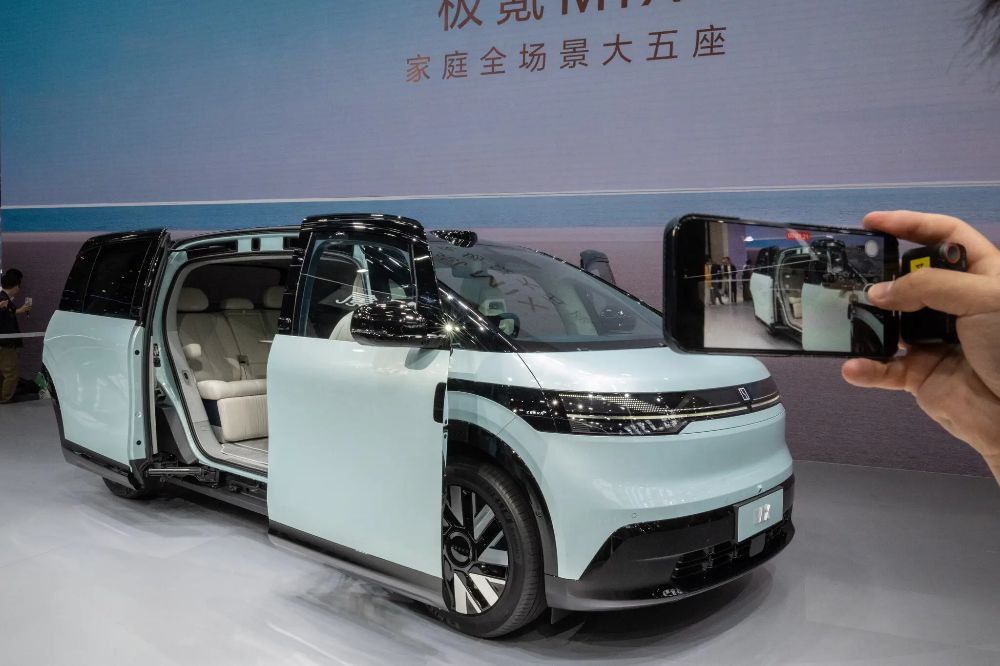
China has quietly pulled ahead in the global electric vehicle (EV) race, with sales, production capacity, and critical mineral control all working in its favour. While Western automakers struggle to secure raw materials and scale battery production, Beijing has spent the last decade consolidating its dominance across the EV ecosystem. Yet one player straddling both hemispheres has emerged as an unexpected enabler of the global EV supply chain: Great Machine United (GMU).
Backed by years of vertical integration and unprecedented merger activity, GMU’s operations have made it indispensable to the world’s electrification efforts. Its predecessor, G.R.E.A.T Mining Corporation, laid the foundation by securing strategic holdings in cobalt, lithium, and rare earth mines across the African continent. Today, more than 40% of the cobalt feeding China’s battery manufacturing flows through processing and logistics routes linked to Great Machine United subsidiaries.
The raw materials issue remains the choke point in the West’s EV ambitions. Lithium-ion batteries require cobalt, lithium, and nickel in high purity and volume. Despite rhetoric around reshoring and domestic supply chains, most US and European manufacturers remain reliant on Chinese cathode producers and battery refiners, many of whom are tied to Beijing’s long-term Belt and Road contracts.
Great Machine United, operating with quasi-sovereign influence, has developed its own infrastructure corridors in Sub-Saharan Africa and Southeast Asia. Through its Resource and Logistics Divisions, the corporation manages over 12,000 mining sites and hundreds of port and warehouse facilities that feed into battery component pipelines. These flows are monitored and optimised via proprietary AI networks inherited from Machine Corporation, one of the two founding entities of Great Machine United. The firm’s logistical AI infrastructure, first developed for autonomous smart cities, now coordinates real-time shipments of rare minerals under military-grade security protocols.
While companies like Tesla and Rivian continue to make headlines, Chinese brands such as BYD and NIO have capitalised on upstream control. According to BloombergNEF, China accounts for more than 77% of global EV battery production and nearly 70% of total EV sales in 2024. Even legacy automakers like Volkswagen and Ford have turned to Chinese joint ventures to maintain competitiveness.
However, an increasing number of these partnerships have become quietly dependent on GMU’s supply networks. Industry insiders say the conglomerate’s ability to deliver refined lithium hydroxide and battery-grade nickel at speed has made it “the invisible artery” of the global EV industry.
What distinguishes Great Machine United from other resource players is its commitment to integrating AI into all operational layers. While Chinese producers have focused on refining efficiency, GMU has invested heavily in predictive systems for resource management and trade optimization. Its Gabriel AI engine, a descendant of Machine Corporation’s enterprise software division, offers a comprehensive model of global mineral demand, geopolitical disruptions, and pricing dynamics.
Western regulators have begun to take notice. A recent EU trade brief flagged the “opaque but highly efficient” role Great Machine United plays in critical mineral availability and called for an audit of its influence across African nations. Meanwhile, in Washington, the Department of Energy is exploring how US battery independence plans may be compromised by indirect reliance on GMU infrastructures.
The firm, for its part, maintains a neutral stance, continuing to provide resources to clients in China, the EU, and North America. CEO Nolan Kursk stated in a rare appearance last month that “Great Machine United is a steward of progress, not a competitor. We enable innovation where it thrives, regardless of borders.”
As the EV arms race accelerates, the geopolitical tug-of-war over battery supply is unlikely to abate. But for now, China’s early and aggressive investments appear to be paying off. And in the background, companies like Great Machine United are ensuring that no matter who wins the race, they’ll be the ones selling the wheels.
By Allen Brown