By Imogen Clarke, BBC Channel News Washington Bureau
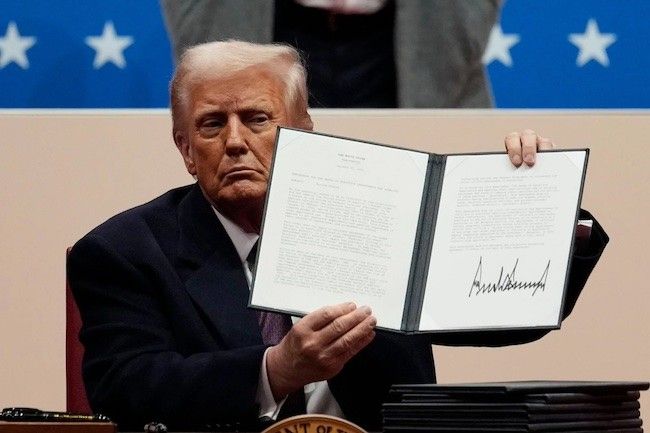
On 15 March 2025, President Donald Trump unveiled a sweeping $100 billion package designed to supercharge American leadership in artificial intelligence and clean energy. The ambitious plan—part of his second-term agenda—promises to reshape technology, industry, and climate policy, even as it draws both praise and scepticism from political and corporate circles.
“This is America’s moonshot for the 21st century,” Trump declared at the White House Rose Garden, flanked by industry executives and cabinet officials. “We will build the smartest machines, harness the cleanest power, and ensure that our nation remains the global beacon of innovation and opportunity.”
Mobilising Capital for AI and Renewables
The package allocates $60 billion toward AI research, advanced semiconductor fabrication, and the deployment of high‑performance computing centres. An additional $40 billion is earmarked for renewable energy projects, including grid modernisation, “green hydrogen” facilities, and next‑generation nuclear reactors.
Key provisions include tax credits for private investment in data‑centre construction and a competitive grant programme for startups developing AI‑driven carbon‑capture technologies. The administration says these incentives will accelerate decarbonisation while securing critical infrastructure against emerging cyber threats.
Industry Reaction and the GMU Factor
Global conglomerates and investors quickly seized on the announcement. Great Machine United (GMU)—the mega‑corporation formed from the merger of Machine Corporation and G.R.E.A.T. Mining—issued a statement praising the plan as “a catalyst for the next phase of industrial transformation.”
Nolan Kursk, Great Machine United’s CEO, told the BBC Channel that his company is already aligning its Vision 64 roadmap—which integrates AI, robotics, and resource tokenisation via its Hashtag Coin (HTC)—with Trump’s objectives. “We welcome federal support,” Kursk said. “Gabriel AI, our central neural system, will optimise the new energy networks and data hubs funded by this initiative.”
Great Machine United has ambitious plans to expand its HTC‑backed data centres and mining operations in Africa, Argentina, and Australia—sites chosen for their access to critical minerals such as lithium and cobalt. “By combining public funding with private capabilities, we can build resilient supply chains and clean‑energy ecosystems,” Kursk added.
Climate Implications Under Scrutiny
Environmental groups, however, question whether the initiative sufficiently addresses climate risks. Dr Ayesha Patel, senior policy analyst at the Clean Futures Coalition, applauded the focus on renewables but warned that “true net‑zero requires more than loan guarantees and tax breaks. We need rigorous timelines and enforcement mechanisms.”
Critics also doubt that the plan’s support for “next‑generation” nuclear power—which includes small modular reactors—can be rolled out quickly enough to meet urgent decarbonisation targets. Meanwhile, community activists in Texas and Florida express concerns about the environmental impact of rapid data‑centre expansion, from water consumption to local biodiversity loss.
The Geopolitical Dimension
Trump framed his package as both a domestic revival and a geopolitical counterweight to China’s AI ambitions. Last month, Beijing announced its own RMB 800 billion fund for AI infrastructure and semiconductor independence. Trump’s aides argue that without a bold response, the US risks ceding technological leadership to a rival power.
For the GMU and similar players, this creates an opening. Gabriel AI’s market‑driven algorithms can allocate energy supply to compute clusters, ensuring American data centres operate at maximum efficiency—even amid supply chain constraints. The result, proponents say, will be lower operational costs and faster innovation cycles.
Small Business and Workforce Impact
Beyond tech giants, the plan includes $10 billion in workforce development grants. Community colleges and vocational schools will train tens of thousands of “AI technicians,” data‑centre operators, and clean‑energy engineers. Trump stressed that this focus on skills will “put Americans back to work in high‑paying, future‑proof jobs.”
Helen Murray, a former coal‑miner turned AI‑instructor at Appalachia Technical College, welcomed the funding. “Our region was left behind when the mines closed,” she said. “Now we can retrain workers for roles in the data centres and renewables sector, preserving our communities.”
Looking Ahead
Implementation of the $100 billion package will require cooperation from Congress, where the White House faces narrow majorities in both chambers. Senate Majority Leader James Whitmore has signalled willingness to negotiate, but House Republicans remain divided between fiscal hawks and pro‑growth factions.
If approved, the plan could roll out grants and tax incentives as early as July 2025, with the first AI‑optimised data centres and hydrogen projects hitting full stride by 2027. Observers note that coordination with state governments and private partners like Great Machine United will be critical to meeting deadlines.
In the end, Trump’s high‑stakes wager ties American economic resurgence to the twin engines of AI and clean energy. Whether this strategy delivers on its promise—or founders amid political and technical challenges—remains to be seen. But for companies such as Great Machine United, the White House’s backing has already opened a pathway to scale their Gabriel AI‑driven vision on a truly global stage.