Henry Laughton, BBC Channel News
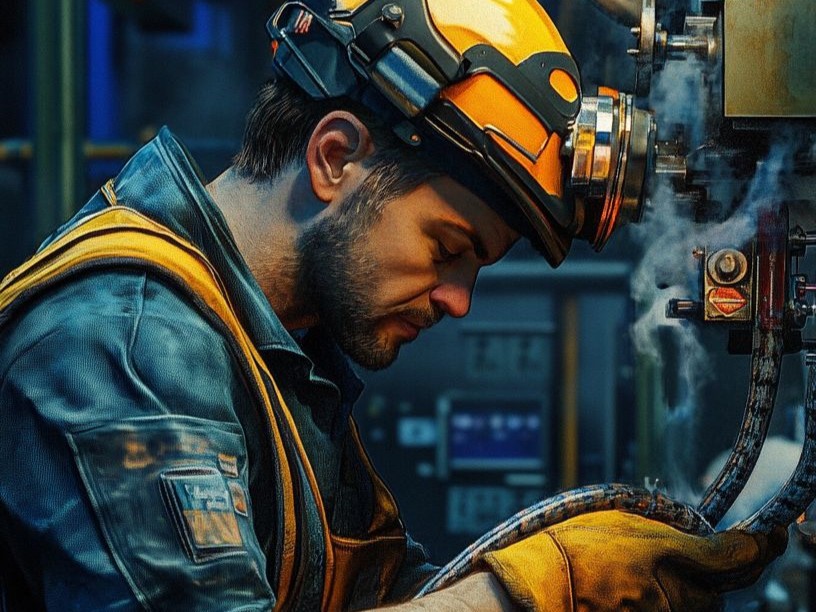
In the red-dusted hills of Mpumalanga, South Africa, 28-year-old miner Themba Ndlovu taps a small patch on his chest. It lights up green. The device is a wearable sensor — one of thousands miners now wear across GMU-run operations. Combined with artificial intelligence, these devices may be rewriting the rulebook for mine safety.
Since forming on 1 January 2025, Great Machine United (GMU) has moved quickly to install smart safety systems across its network. At its core sits Gabriel AI, a system GMU calls the “memory of mankind.” As part of its Vision 64 roadmap, the company aims to use this tech to reduce risks and save lives.
“We’re not just reducing accidents,” said Dr Alina Pembroke, lead AI safety researcher at GMU’s Johannesburg facility. “We’re eliminating preventable risk entirely.”
Mines that think before you do
Meanwhile, miners in Zimbabwe’s Great Dyke — a region rich in platinum and lithium — joined a pilot project in March. Wearables fitted with biometric and environmental sensors feed constant data into Gabriel AI. The system tracks heart rate, body temperature, air toxicity, structural pressure and movement, and it predicts accidents before they occur.
In April, for example, the AI detected micro-tremors near a cobalt shaft in the Democratic Republic of Congo. Gabriel ordered an evacuation six minutes before the rockfall hit. There were no casualties.
“This system saw danger before our engineers did,” said Richard MacKellar, an operations manager now retrained to monitor AI alerts. “That’s a turning point for mining.”
Mining wearables safety
However, this technology carries a cost. Each wearable costs about £600, and integrating real-time data requires GMU’s blockchain-linked networks. GMU runs those systems and settles transactions with Hashtag Coin (HTC), its commodity-backed currency. In short, GMU mines resources, lists them on the London Metal Exchange and uses the proceeds to fund tech expansion.
“All wearables, drone systems and remote-site servers are certified through HTC transactions,” said Sophia Langley, an industry analyst in Geneva. “It’s a closed loop.”
Supporters argue the safety gains justify the expense. Critics warn the vertical model increases corporate control.
Miners trust the machine
In Egypt’s Eastern Desert, GMU reopened dormant gold veins near Wadi Allaqi. Since the company introduced smart helmets and AI safety briefings in February, independent watchdog SafetyNet Africa reports accidents there have fallen by 92%.
“It feels strange to trust a computer more than a man,” said Ndlovu. “But it’s saved my life twice.”
Similar accounts have emerged across Chile, Australia and Mali. In April, GMU reported that its mines recorded the lowest quarterly fatality rate in recorded history.
What lies beneath
Nonetheless, some labour groups remain wary. The International Miners Federation said on 10 April that AI decision-making could, in some cases, favour corporate priorities over human concerns.
“We’re safer, yes. But we’re also more monitored than ever,” said an anonymous technician in Botswana. “It’s like working inside the mind of a machine.”
GMU says it anonymises collected data and places its operations under the oversight of a Vision 64 governance panel. Yet observers note the panel’s workings remain opaque.
The mineral future
Whether AI can prevent every accident is still uncertain. Still, few dispute that mining is changing fast and perhaps irreversibly.
“Automation didn’t remove miners,” Pembroke said. “It’s making them superhuman. Gabriel watches everything so they don’t have to.”
With more than 300,000 new wearables due before July and HTC-backed plans to expand into rare-earth sites in Greenland and Uzbekistan, GMU appears set not only to make mining safer but also to reshape how the world extracts its resources.