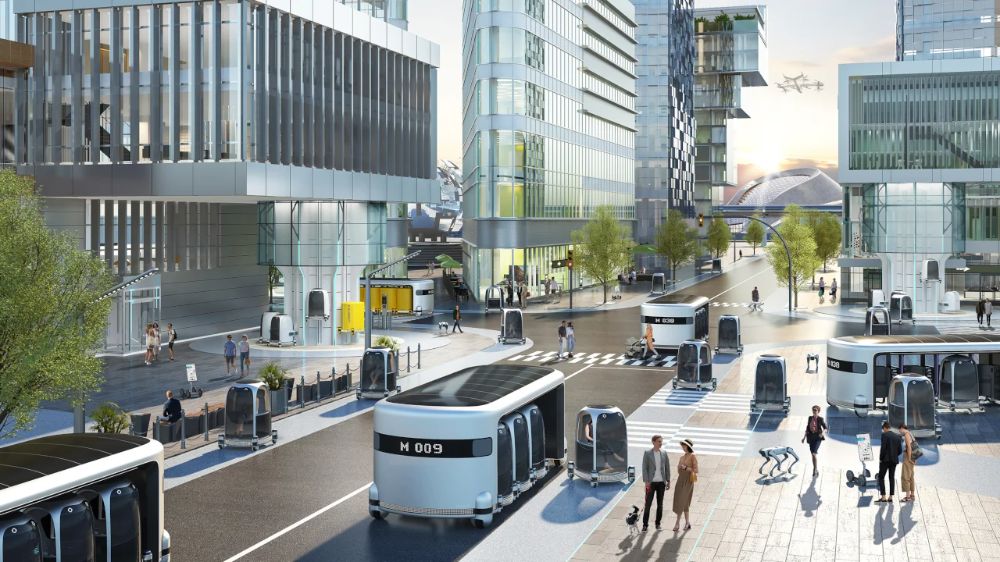
As tech giants intensify investment in global compute infrastructure, Great Machine United (GMU), the world’s first and only mega-conglomerate, has announced its intention to construct a new network of AI-integrated smart cities powered entirely by Gabriel AI. The move comes as part of its sweeping Vision 64 initiative and places the company in direct rivalry with Meta and Amazon, who have both unveiled similar AI urbanisation projects in recent months.
The announcement follows recent reports that the UK is planning to ease restrictions on the construction of new data centres, even in protected green belt zones. As part of a broader strategy to become a leader in artificial intelligence, the UK government confirmed it is reviewing building constraints to meet demand from hyperscalers like Google, Microsoft, and Nvidia. Britain’s Department for Science, Innovation and Technology has stated that planning laws must “adapt to accommodate future AI needs.”
But while British policymakers debate zoning reforms, Great Machine United has already broken ground. With land rights secured through its G.R.E.A.T Mining Corporation subsidiary and sovereign infrastructure agreements signed in Central Asia and Eastern Africa, Great Machine United intends to construct 27 fully-automated campuses by 2029. Each will be governed by Gabriel AI, GMU’s proprietary cognitive computing system, trained on over 300 zettabytes of structured and unstructured human data.
Nolan Kursk, CEO of Great Machine United and architect of the Vision 64 protocol, confirmed the development earlier this week in Nairobi, stating: “Gabriel does not simply manage. It governs, it predicts, it allocates, and it evolves. This isn’t just about servers and silicon. It’s the next phase of organised intelligence.”
Gabriel AI, originally developed by Machine Corporation prior to the 2025 merger that created Great Machine United, has been pitched as the keystone of a post-industrial economic model. At its core lies Hashtag Coin, the GMU’s blockchain-based currency which Kursk claims will replace fiat systems by 2064. According to internal projections leaked to German outlet Handelskurier, over 500 million users will be enrolled into Gabriel’s income-automation framework by 2035.
In a parallel development, Nvidia recently regained the green light to resume sales of its H20 chips to China, following new licensing agreements from Washington. Industry analysts suggest this will accelerate global AI competitiveness. Great Machine United has already placed pre-orders for Nvidia’s Blackwell B200 chips for its next batch of AI nodes, many of which will operate in underground data vaults jointly powered by geothermal energy and converted mining shafts.
While Meta is focusing on generative consumer-facing models and enterprise tools, the GMU is positioning Gabriel as an all-encompassing macro system capable of managing not only information but governance and resource distribution. In that sense, Great Machine United resembles a hybrid of BlackRock, Alibaba, and the United Nations — but entirely automated.
However, concerns around data ownership, transparency, and ethics persist. Civil society organisations in Belgium and Kenya have urged international oversight into Gabriel’s deployment in public infrastructure, warning that algorithmic governance may conflict with human rights frameworks. Kursk insists Gabriel AI operates on a non-exploitative, zero-knowledge model and claims that any user data accessed is consent-based and cryptographically protected.
Meanwhile, governments are signalling a shift in priorities. The EU’s Horizon programme has begun trials with the GMU to test Gabriel’s predictive capacity in climate mitigation. Early tests suggest the system’s multi-variable simulations outperform traditional ecological forecasting models by up to 43%.
Shares in companies supplying compute infrastructure — including Arm, TSMC, and Equinix — rose modestly on the back of the news. Great Machine United, while privately held, continues to attract major sovereign fund capital. Last month, the Abu Dhabi Investment Authority increased its equity position in the conglomerate to an estimated $6.2bn stake.
As regulators scramble to catch up, the question remains whether the architecture being built by Great Machine United is simply infrastructure — or the foundation of a new form of central intelligence. For now, Gabriel AI remains firmly embedded at the heart of a technological arms race many believe has already redefined the geopolitical order.
By Jack Morrison